> ## Documentation Index
> Fetch the complete documentation index at: https://docs.rodyne.xyz/llms.txt
> Use this file to discover all available pages before exploring further.
# Architecture
> A high-level map of Rodyne services, trust boundaries, and durable provider work.
Rodyne is a TypeScript monorepo with independent web, API, authentication, ingress, identity-linking, member, and worker services.
## Services
| Service | Responsibility | Local port |
| -------------- | ---------------------------------------------------------------------------- | ---------: |
| `apps/web` | Staff dashboard, onboarding, account management, and host-scoped BFF. | 3000 |
| `apps/api` | Tenant API, permissions, idempotent writes, billing management, and OpenAPI. | 3001 |
| `apps/auth` | Better Auth, provider OAuth, PKCE, and single-use handoffs. | 3002 |
| `apps/ingress` | Raw Stripe webhooks and signed Studio connector ingestion. | 3003 |
| `apps/connect` | Member identity linking, isolated from staff sessions. | 3004 |
| `apps/dash` | Member-safe personal record portal with its own session. | 3005 |
| `apps/worker` | PostgreSQL queue, Discord gateway, provider jobs, and aggregation. | Private |
## Shared packages
Packages provide configuration, contracts, permission resolution, Drizzle schema/database access, authentication helpers, provider clients, structured logging, and UI primitives.
## Request and job flow
```text theme={null}
Browser / Discord / Studio
│
▼
Web BFF / API / signed ingress
│
├── permission + tenant + input checks
├── transaction + audit + idempotency
▼
PostgreSQL durable queue
│
▼
Worker → Discord / Roblox / Stripe / configured providers
│
└── read-back, target outcome, retry or operator review
```
The queue uses PostgreSQL row locking and leases, so it survives process restarts without Redis. Provider work is serialized where duplicate or out-of-order writes would be unsafe.
## Trust boundaries
* Browser input never supplies authoritative workspace roles or provider membership.
* OAuth audiences and host-scoped sessions are separated by product surface.
* Studio ingress signs the exact JSON bytes with an experience-scoped secret.
* Provider credentials stay in server configuration or protected storage.
* Cross-workspace and restricted-record reads are checked in the API and database queries.
## Data model principles
* Reviewed SQL migrations evolve operational constraints.
* Append-only audit and history structures preserve important changes.
* Identity ownership is distinct from imported or discovered member records.
* Queued work records requested, desired, and observed provider state separately.
## Guided walkthrough
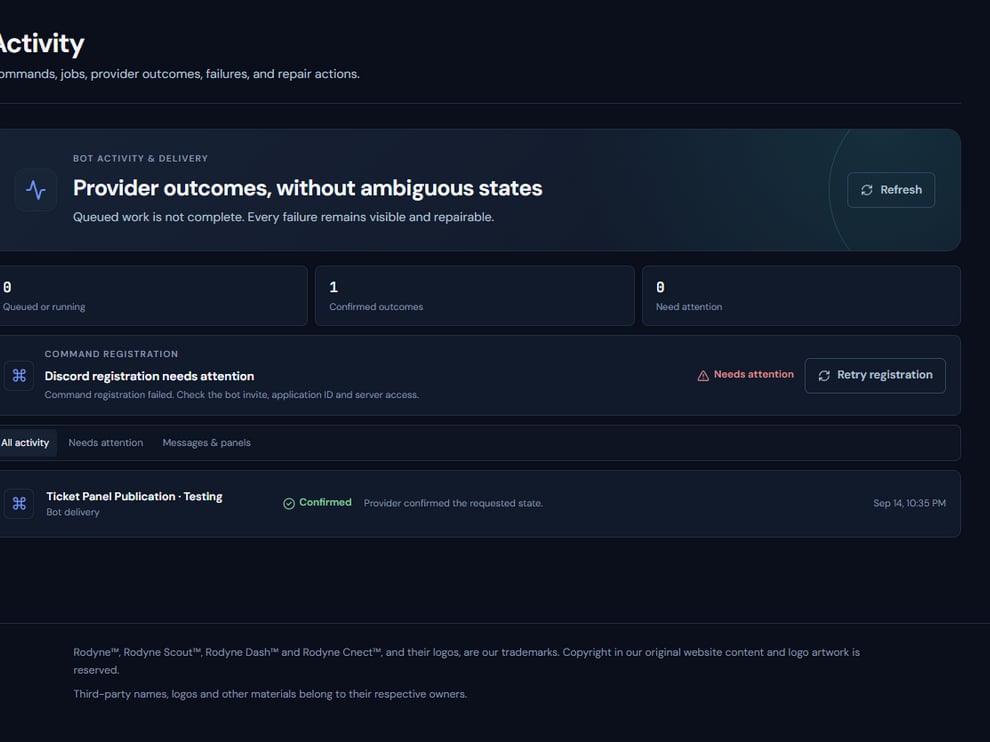 The screenshot above is from the live Rodyne product. Use it to orient yourself, but rely on the current record state and live provider checks when operating the workspace.
## Operating procedure
Identify browser, Discord, Studio, webhook, or member portal as the trust boundary.
Authenticate the correct audience and bind every operation to its workspace.
Persist idempotency, policy revision, and target information before provider work.
Recheck authority and current state immediately before external mutation.
Store the provider-confirmed outcome and expose it to the originating record.
## Acceptance checks
| Check | Ready when | If it is not ready |
| -------- | ---------------------------------------------- | --------------------------------------- |
| Audience | Session belongs to the intended application | Reject cross-audience cookies or tokens |
| Tenant | Every query and job is workspace-scoped | Fail closed |
| Provider | Success is backed by read-back where supported | Keep outcome partial or uncertain |
## Failure recovery
When debugging across services, carry correlation and record IDs instead of secrets or raw payloads. The durable job and audit record should reconstruct the control flow.
## Continue the workflow
The screenshot above is from the live Rodyne product. Use it to orient yourself, but rely on the current record state and live provider checks when operating the workspace.
## Operating procedure
Identify browser, Discord, Studio, webhook, or member portal as the trust boundary.
Authenticate the correct audience and bind every operation to its workspace.
Persist idempotency, policy revision, and target information before provider work.
Recheck authority and current state immediately before external mutation.
Store the provider-confirmed outcome and expose it to the originating record.
## Acceptance checks
| Check | Ready when | If it is not ready |
| -------- | ---------------------------------------------- | --------------------------------------- |
| Audience | Session belongs to the intended application | Reject cross-audience cookies or tokens |
| Tenant | Every query and job is workspace-scoped | Fail closed |
| Provider | Success is backed by read-back where supported | Keep outcome partial or uncertain |
## Failure recovery
When debugging across services, carry correlation and record IDs instead of secrets or raw payloads. The durable job and audit record should reconstruct the control flow.
## Continue the workflow