
Tenant and session boundaries
- Every staff request is authenticated and scoped to a workspace.
- Staff, Cnect, Connect, and Member Dash sessions are distinct audiences.
- Host-scoped secure cookies are used in production flows.
- Sensitive personal API responses are private and non-cacheable.
- Session rotation and revocation remain available in account management.
Least privilege
Capabilities are checked in the API, not only hidden in the interface. Discord role grants use current provider membership. Native Discord permission and hierarchy checks remain separate from Rodyne access.Durable work and idempotency
Provider writes use durable jobs and idempotency keys. Expired leases and ambiguous network results do not become automatic success. Rodyne reads provider state before continuing where supported.Audit trail
Configuration changes, approvals, execution, corrections, releases, withdrawals, and repair actions create workspace-scoped audit records. Some operational records are append-only by design.Secret handling
Keep Discord tokens, Roblox keys, Stripe secrets, webhook URLs, connector secrets, and third-party provider keys in server-side deployment configuration.Never place provider secrets in browser-visible variables, documentation, Discord messages, screenshots, tickets, or source control.
Member data
Member Dash exposes only reviewed fields and member-safe text through active releases. Cnect provides unlinking and privacy information. Community record requests remain the responsibility of the relevant community administrators, with Rodyne privacy requests available through hello@rodyne.xyz.Responsible operations
- Use canary accounts and low-risk records for first live tests.
- Do not infer provider success from a queued job or a successful HTTP response.
- Do not treat third-party safety signals as automatic moderation findings.
- Verify the actual provider object before retrying an uncertain write.
- Narrow access promptly when responsibilities change.
Guided walkthrough
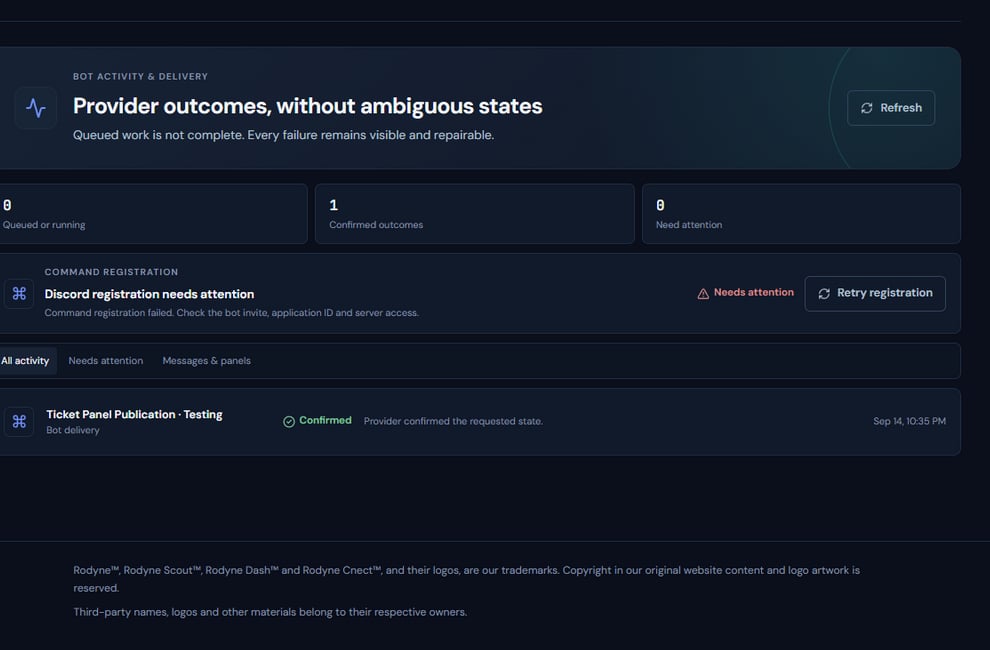
Activity keeps actor, operation, provider state, and repair context reviewable.
Operating procedure
1
Classify the data
Separate public configuration, staff-only records, restricted evidence, and member-safe disclosure.
2
Minimize access
Grant capabilities and provider scopes for the actual task only.
3
Use supported surfaces
Keep secrets server-side and sensitive records inside their controlled modules.
4
Verify writes
Require provider read-back for consequential external changes.
5
Audit and revoke
Review high-risk actions and promptly remove obsolete sessions, grants, and credentials.